November 15, 2025
The selection of the wine closure system has gained increasing importance in recent years. Today, it is clear that the type of closure can decisively influence the chemical and sensory evolution of wine—even over relatively short storage periods.
To explore this complex interaction between wine and closure, MA Silva, in collaboration with the University of Aveiro, conducted a comprehensive study to examine the effects of different closure systems on the evolution of red wine during short- and medium-term storage (5 to 35 months). Using a rigorous methodology based on multiple chemical and sensory indicators, the authors assessed how different closures influence oxidation, reduction, and the phenolic and aromatic evolution of wine, proposing practical solutions to adapt the closure to the wine style and expected consumption timeframe.
The sensory characteristics of wine are a topic studied by several researchers over time, but it continues to be a current and challenging subject. These characteristics are fundamental for the consumer acceptability, which has increasingly aroused their interest to modulate them in line with current market trends and innovation demands. The wine physical-chemical and sensory properties depend on a wide set of factors: they begin to be designed in the vineyard and are later constructed during the various stages of winemaking. Afterwards, the wine is placed in bottles, to be stored, for a specific period or to be commercialized.
During post-bottling, the wine may suffer several physical-chemical changes, modulated by the position of the bottle, type of stopper, temperature, and storage time, among others, which impact on the oxygen entrance ratio.
In fact, the permeability of the stoppers to oxygen is considered one of the most important properties that influences wine sensorial properties during post-bottling, however the understanding what happens in this wine-cork system will have a multifactorial nature that is not yet well established.
Therefore, a study was designed with the aim of holistically evaluating the impact of using different types of stoppers on different red wines, for short to medium storage times: red wines from Burgenland (Austria) and from Douro Appellation (Portugal) were stored in a horizontal position for 5 and 35 months, respectively, using natural cork stoppers, different types of microagglomerated cork stoppers and Screw Cap tin liner.
To achieve a holistic view of the changes that may occur during bottling, a set of analysis were implemented to characterize red wines sealed with different stoppers:
The OTR (Oxygen transfer rate) was determined for the different types of stoppers, by chemoluminesce.
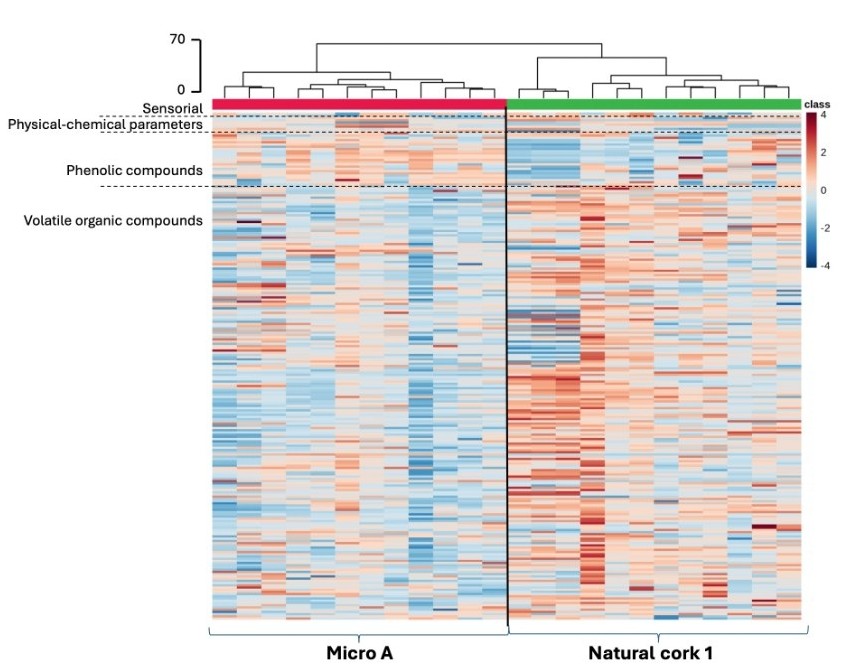
Natural Cork 1 vs Microagglomerated Cork (Micro A)
Figure 2. Dendrogram and heatmap representation of Douro red wines sealed with Natural Cork 1 and Micro A stoppers: (a) the 196 volatile compounds identified, organized by chemical families separated by dashed lines; and (b) the combined information domains, including sensorial analysis, physicochemical parameters, phenolic compounds, and volatile organic compounds. Euclidean distances are included on the dendrogram Y-axis. A chromatic scale (from dark blue, minimum, to dark red, maximum) was used for each variable, normalized by autoscaling. Figure adapted from Foods 2025, 14, 783 (https://doi.org/10.3390/foods14050783).
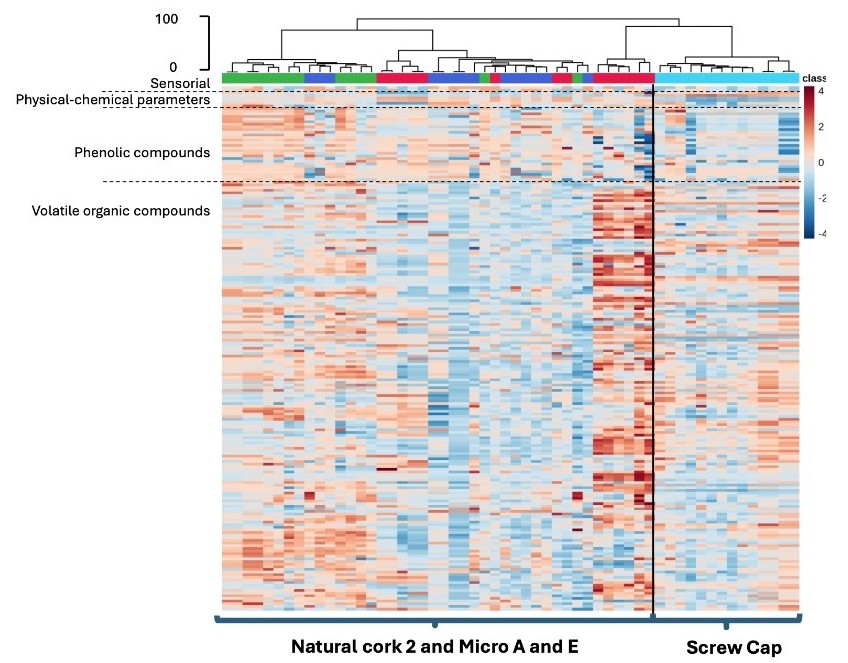
Natural Cork 2 vs Microagglomerated Cork (Micro A and Micro E) | Screw cap tin liner (Screw cap)
Figure 3. Dendrogram and heatmap representation of Burgenland red wines sealed with Natural Cork 2, Micro A, Micro E, and screw cap closures: (a) the 161 volatile compounds identified, organized by chemical families separated by dashed lines; and (b) the combined domains of information, including sensorial analysis, physicochemical parameters, phenolic compounds, and volatile organic compounds. Euclidean distances are included on the dendrogram Y-axis. A chromatic scale (from dark blue, minimum, to dark red, maximum) was used for each variable, normalized by autoscaling. Figure adapted from Foods 2025, 14, 783 (https://doi.org/10.3390/foods14050783).
The results allows to infer that more reductive conditions for wine bottled using Screw Cap tin liner were observed:
The oxidation mechanism that derives in wine changes during bottle storage may promotes several oxidative reactions will alter in different ways each wine. These reactions are more evident on wine bottled with natural cork stoppers. Under gentle oxidative conditions may occur:
Differences are more pronounced for longer storage time.
For more information on the research or other technical aspects, visit the following link: www.masilva.pt/en/masilva-en/
Acknowledgments:
funds through the FCT/MEC (PID-DAC), and by MASilva in the scope of the service provision contract with the University of Aveiro. FCT is also acknowledged for the research contract under Scientific Employment
Stimulus to Sónia Santos (2021.03348.CEECIND).
Mota, J.; Viana, A.; Martins, C.; Pais, A.C.S.; Santos, S.A.O.; Silvestre, A.J.D.; Machado, J.P.; Rocha, S.M. Pairing Red Wine and Closure: New Achievements from Short-to-Medium Storage Time Assays. Foods 2025, 14, 783. https://doi.org/10.3390/foods14050783
This article content was published on https://www.infowine.com/en/wine-closure-pairing-an-old-challenge-with-new-solutions/